Music of the Heart

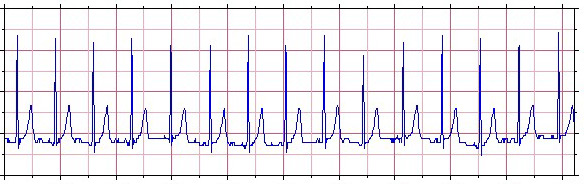
The Music of the Heart was an interactive hands-on exhibit at the Boston Museum of Science based on a collaboration between Boston University's Complex Systems Science Education Lab and Beth Israel Deaconess Medical Center's ReyLab. The "heart music" is derived from electrocardiogram (ECG) data— actual digital recordings of the electrical signals of the human heart. The hands-on exhibit at the Boston Museum of Science allowed museum-goers to hold onto bars to record their own electrocardiogram of approximately 25 beats and, in real time, listen to the 'music' it produced. Heart music you would hear at the museum exhibit, based only on mapping the raw data to pitches, sounds something like this:
The Music of the Heart was featured in The Sacred Balance (2002) television series hosted by David Suziki which included an interactive online game allowing visitors to hear recordings similar to those created in real-time at the hands-on exhibit. Data from overnight electrocardiogram recordings were also used to create music. The audio CD HeartSongs accompanied the exhibit. These heart songs began as musical notes mapped from the heartbeat data. The composer then added harmonies and rhythm to make pleasant sounding music. Listen to these "composed" heart songs. Can you tell which compositions are based on "healthy" heart data? Hint: read below. Heartsong 1: Heartsong 2: Heartsong 3: Heartsong 4: Heartsong 5: Heartsong 6: Heartsong 7: Heartsong 8: Heartsong 9: Heartsong 10: Heartsong 11: Heartsong 12: Heartsong 13: Heartsong 14: Heartsong 15: Heartsong 16: Heartsong 17: Heartsong 18: Heartsong 19: How can your heart make music?
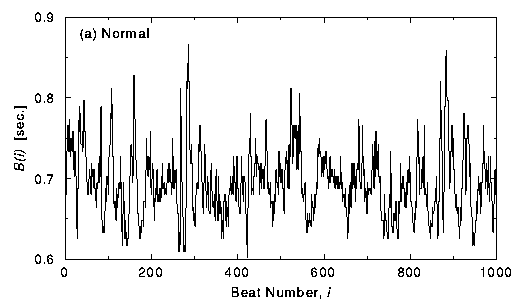
In the first of four stages, we obtained digital tape recordings of the heartbeat using a Holter monitor, a pocket-sized ECG recorder that can store thousands of consecutive heartbeats (as shown in the figure) over an entire day. Next, using a computer, we measured the precise intervals between the heartbeats, creating a graph of the instant-to-instant changes in heart rate as a function of time.
While your pulse may feel perfectly regular, you actually have a
great deal of subtle variability from one beat to the next. These
fluctuations are produced by the normal functioning of the involuntary
nervous system, which can cause your heart to slow down or speed up.
The normal heartbeat, therefore, does not follow a metronomic or
march-like beat–suprisingly, it has a dance-like plasticity and
variability.
The third step in creating these heartsongs was to convert the time intervals between heartbeats into integers. We used a simple computer program to generate roughly 330 integers per data set. We started with 100,000 recorded heartbeats (roughly a 24 hour period), then calculated the average of every 300 beats. We averaged the beats to remove very short-term fluctuations caused by movement or breathing. The product of these musical mappings raises a fundamental question. Why does the healthy heart create musically pleasing or interesting note sequences, whereas the diseased heart create boring repitition? The answer may lie in the origin of heart rate variability regulated by our nervous systems. The result is a complex pattern of variations present in normal heartbeats but absent in sick heartbeats that have been shown to have the mathematical structure of a fractal; see our Patterns in Nature curriculum. The term fractal describes objects such as snowflakes and coral formations, which are composed of smaller units resembling the larger scale form–a property called self-similarity. Fractals have been shown to be relevant to a wide range of natural phenomena. This term also applies to complex processes that are made up of different frequency components with a special type of scaling relationship to each other. Work by Richard Voss and John Clarke have shown that some classical music has this type of scaling pattern. These recordings are, to our knowledge, the first effort to use actual rhythms of the heart as the template for musical composition. The musicality of these recordings raises a further question: could the composition of music involve, at least in part, the re-creation by the mind of the body's own naturally complex rhythms and frequencies? Perhaps what the ear and the brain perceive as pleasing or interesting are variations in pitch that resonate with or replicate the body's own complex (fractal) variability and scaling. The musical pieces recorded here cannot resolve this question, but may challenge the imagination and delight the ear. Explore Further: If you would like to replicate this experiment and create your own music, you can download heart-rate time series from PhysioNet. MP3 audio files are available by request (see contact below). The Music of the Heart involved the contributions of several individuals, including C.-K. Peng, Ary Goldberger, and Zach Goldberger (Beth Israel), Gene Stanley and Paul Trunfio (Boston University) and Steve Burns (MIT). For more information, please contact Paul Trunfio (or e-mail trunfio@bu.edu).

|